Federated Authentication and SSO (Or: “Did You Forget Your ‘Badge’?”)
SAML, SCIM, OpenID Connect, and OAuth explained through federated authentication and SSO.
TL;DR Too lazy to read? Click here.
Imagine a large international airport: a hub of activity where thousands of passengers, employees, and customers move about every day. Each individual in this space has an identity and a specific purpose, and security is paramount. Let us take the example of a pilot, a central figure in this scenario.

A pilot needs to access several restricted areas of the airport — from flight briefing rooms to runways. In the past, different areas required different forms of identification, such as physical badges or access codes. However, adopting federated authentication simplifies this process. With it, the pilot uses a single identification badge — a unified credential recognized by all of the airport’s security systems. This credential is validated by a central system, which authenticates the pilot’s identity and provides access to the necessary areas based on their profile and the day’s needs.

Furthermore, the pilot’s access permissions are not static. Depending on the day’s flight, destinations, or security levels, the system, supported by the OAuth protocol, can dynamically adjust access levels. This means that on one day the pilot may have access to an international briefing room, while on another their access is restricted to domestic flights. OAuth allows this flexibility, managing access based on parameters that change in real time, ensuring that access is granted only to the information and areas relevant to the pilot at that specific moment.
Just as a pilot navigates different areas of an airport, internet users move between various online services and platforms. As the fabric of cyberspace expands, federated authentication emerges not merely as a solution but as a strategic imperative. The era of “Big Data” and “IoT” has not only expanded the scope of identity management but also complicated its nuances.

This complexity is caused by the advancement of standards such as SAML 2.0, which now integrates more deeply with cloud technologies, and OpenID Connect, which has evolved to embrace JWT standards, facilitating flexibility and security. Take a look:
The Evolution of SAML: From XML to the Cloud
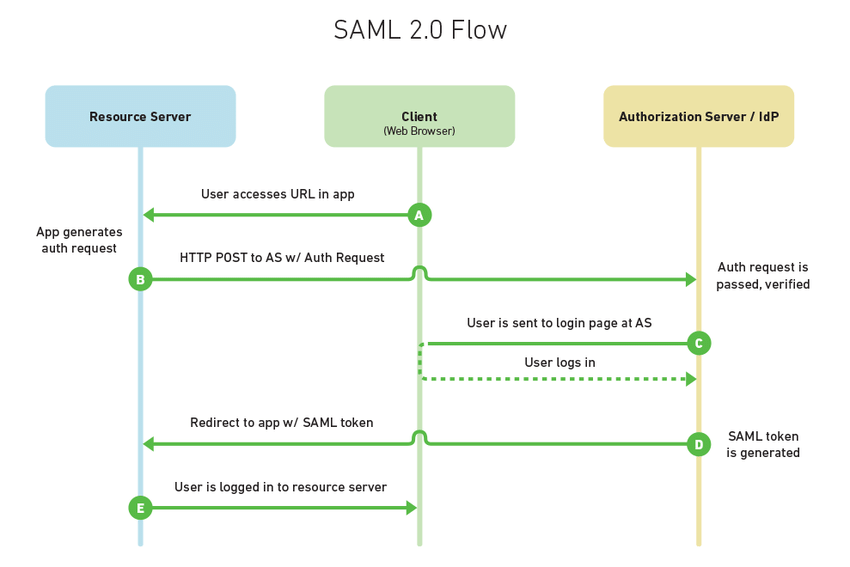
SAML (Security Assertation Markup Language) is an XML-based protocol developed to facilitate secure authentication and authorization communication between distinct domains — essential for enabling the implementation of SSO (Single Sign-On).
With SAML-based SSO, users can log in once and gain access to various systems, services, and applications without the need for repeated authentication. This not only enriches the user experience but also strengthens the security posture by reducing the attack surface through fewer authentication points.
By integrating SSO via SAML with modern security and identity governance controls, organizations can provide streamlined, protected access in line with the highest compliance standards and best practices.
SCIM: Identity Synchronization in the Cloud
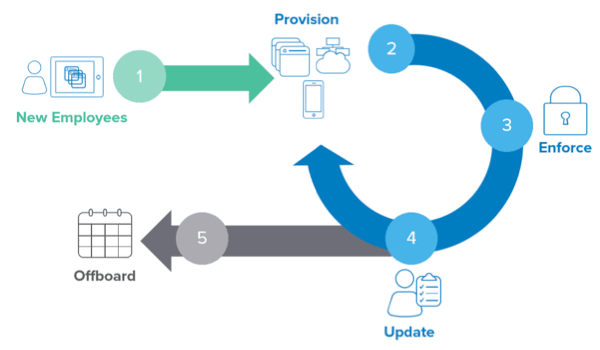
SCIM (System for Cross-domain Identity Management) is an open specification that enables the automated maintenance of user identities across various platforms on the internet.
It serves as a common language that facilitates the automation of identity information exchanges between platforms.
Taking a REST-based approach, it provides CRUD for user identities, facilitating integration with IDaaS (Identity-as-a-Service) such as Okta or Azure AD.
This allows companies to automate user provisioning and deprovisioning processes, quickly adapting authorizations as employee roles change, etc…
This automation is highly beneficial in environments that require continuous identity synchronization between on-premise systems and cloud services, helping reduce the administrative burden and minimize human errors.
OIDC and Convergence with Blockchain Technologies
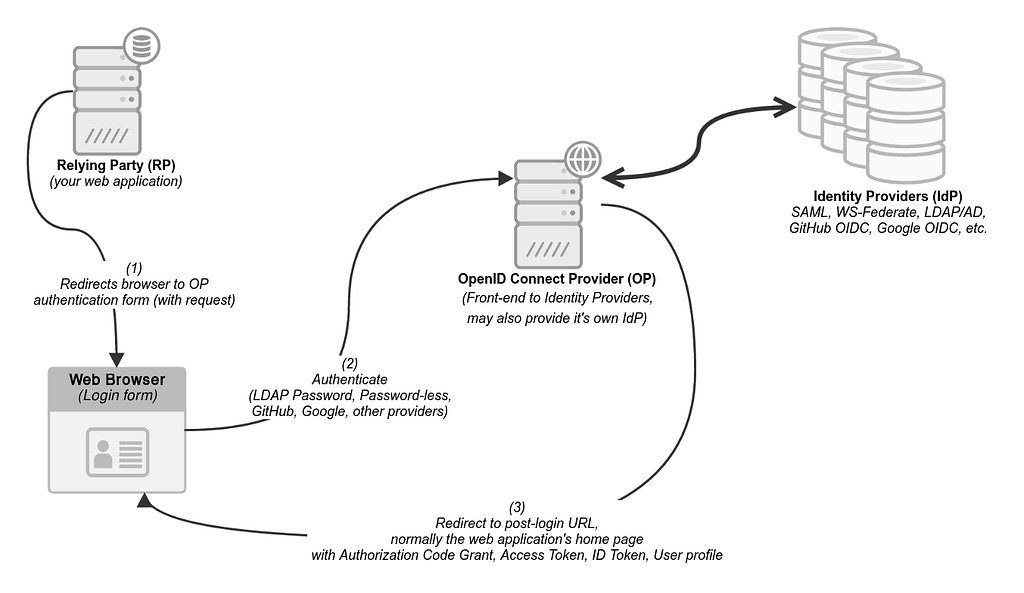
OIDC (OpenID Connect) is an authentication layer built on top of the OAuth protocol, allowing clients of all types, whether in web, mobile, or desktop applications, to verify the user’s identity simply and securely. The use of standardized tokens in JWT (JSON Web Token) format, which contain information about the user’s identity, makes OIDC a powerful and flexible solution for managing digital identities.
Detailed Aspects of OIDC:
- OIDC Protocol Flow: Using the token flow of OAuth 2.0, OIDC adds the ID token, a type of digitally signed token containing claims about the user’s authentication. This token is sent to the client after a successful authentication process conducted by the authorization server.
- Compliance and Security: OIDC plays a fundamental role in providing a verifiable identity across different domains. This is essential for complying with global regulations, such as the GDPR, which requires clients capable of confirming the identity, origin, and time of the user’s authentication.
- OpenID Provider (OP): A service that authenticates the user and issues an ID token. The OP can be a familiar identity service, such as Google, or a custom enterprise identity management system.
Current Examples of OIDC Deployment:
- Social media login: Services such as Google and Facebook use OIDC to offer a consistent login experience and secure authentication across different services, for both native applications and websites.
- Government Applications: Government agencies use OIDC to provide access to portals and systems, ensuring an extra layer of security and traceability.
- Healthcare: OIDC can be used in healthcare platforms to protect patients’ sensitive data, allowing access only to authenticated and authorized users and applications.
- IoT and Smart Devices: In a context where smart devices need to authenticate to access cloud services, OIDC provides a suitable, secure, and standardized means of authentication.
The strategic incorporation of OIDC into the authentication and access ecosystem not only provides flexibility and openness to the digital world, but also meets the growing demand for decentralized authentication methods when combined with technologies such as blockchain, enhancing federated authentication capabilities with greater transparency and a reduction in the risks associated with data centralization.
With its adaptability to different application scenarios and its alignment with technological advances, OIDC is indispensable for architecting a digital infrastructure that is secure, scalable, and user-centered.
OAuth 2.0: From API Access to the Token Economy
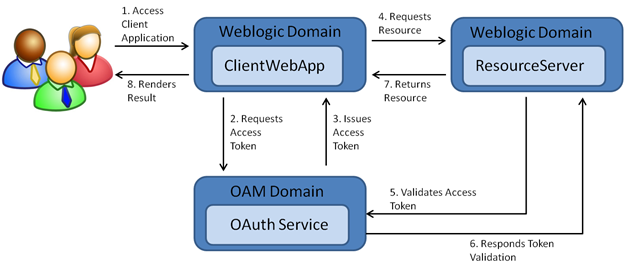
OAuth 2.0 is an authorization protocol that has become the standard for secure, delegated authentication on the web. With its flexible approach, it allows applications to request limited access tokens, offering secure ways to give users control over access to their data without sharing their credentials.
The success of OAuth 2.0 lies in its simplicity and adaptability. It provides distinct grant flows to suit a variety of application scenarios, from back-end servers to web browser clients and native applications. This enables a customized implementation that best meets the security needs of each case.
Practical Usage Examples:
- Third-party Application Integrations: Allows services such as Spotify or PayPal to integrate with other applications, granting access to selected data without exposing user credentials.
- Mobile and Desktop Apps: Enables applications to request access to resources such as contacts and files in services like Google and Microsoft OneDrive in a controlled manner.
With its modular and extensible approach, OAuth 2.0 serves as a reliable foundation for complex authentication and authorization management strategies across a wide variety of applications, simplifying and standardizing how access to data and services is managed online.
To Sum It Up
The technologies we have discussed — federated authentication, SAML, SCIM, OIDC and OAuth 2.0 — form a backbone of security, much as identification and access systems control the flow of people in a busy airport. Just as a single badge can give a pilot access to various areas of the airport, from the flight briefing room to the runway, federated authentication allows users to move effortlessly around the internet, accessing a variety of services with a single set of credentials.
The dynamism and efficiency of the OAuth 2.0 protocol mirror the flexibility with which airport security must operate — adjusting access precisely as needs and circumstances vary. Each technology covered is like a vital part of the airport’s complex system, essential to maintaining order, efficiency, and security.
With continuous advances and innovations like these, we are building the infrastructure needed for a secure and accessible digital ecosystem, where freedom of movement for data and applications is as fundamental as it is for people in an airport.